
Why ESG matters for Media and Entertainment
The Media and Entertainment (M&E) industry is closely tied to environmental, social and governance (ESG) concerns. Content creation and distribution require significant energy and resources, and the industry’s growing dependence on digital platforms is adding to that footprint. Research by InterDigital and Futuresource estimates that the TV and video industry accounts for approximately 4% of global emissions across its value chain, from production to delivery and consumption.
The growth of AI adds another dimension to this challenge. India’s M&E Global Capability Centres (GCCs) are evolving into AI-driven innovation hubs, as global media companies increase investments in generative AI, Agentic AI and automation across content, advertising and streaming operations. According to EY’s 2025 GCC Pulse Survey, 83% of Indian GCCs are investing in generative AI, while 58% are investing in Agentic AI. These developments bring additional requirements for computing infrastructure, data processing, and cooling, making energy efficiency an increasingly important consideration.
The pressure extends beyond environmental performance. Content shapes audience perceptions, placing greater responsibility on media companies to address diversity and inclusion in their output. Fair labour practices, employee well-being and responsible technology use are also part of the industry’s wider ESG commitments.
Investors, advertisers, and employees are also paying closer attention to how businesses approach these responsibilities. For M&E companies, this raises the question of how ESG imperatives are influencing their relationship with some of the most important stakeholders—talent, audience & clients.
Closing The Gap Between Targets & Measurable Action
Major media and entertainment companies are setting formal emissions targets. An industry analysis reported that nine out of ten major film and television companies had set emissions targets for 2035 or earlier, with five of the nine targets approved by the Science Based Targets initiative (SBTi).
The challenge is translating these commitments into measurable improvements. Emissions arise at different stages of the value chain—from content production and energy consumption to distribution. Tracking these sources and demonstrating progress requires clear baselines, defined measures, and consistent reporting.
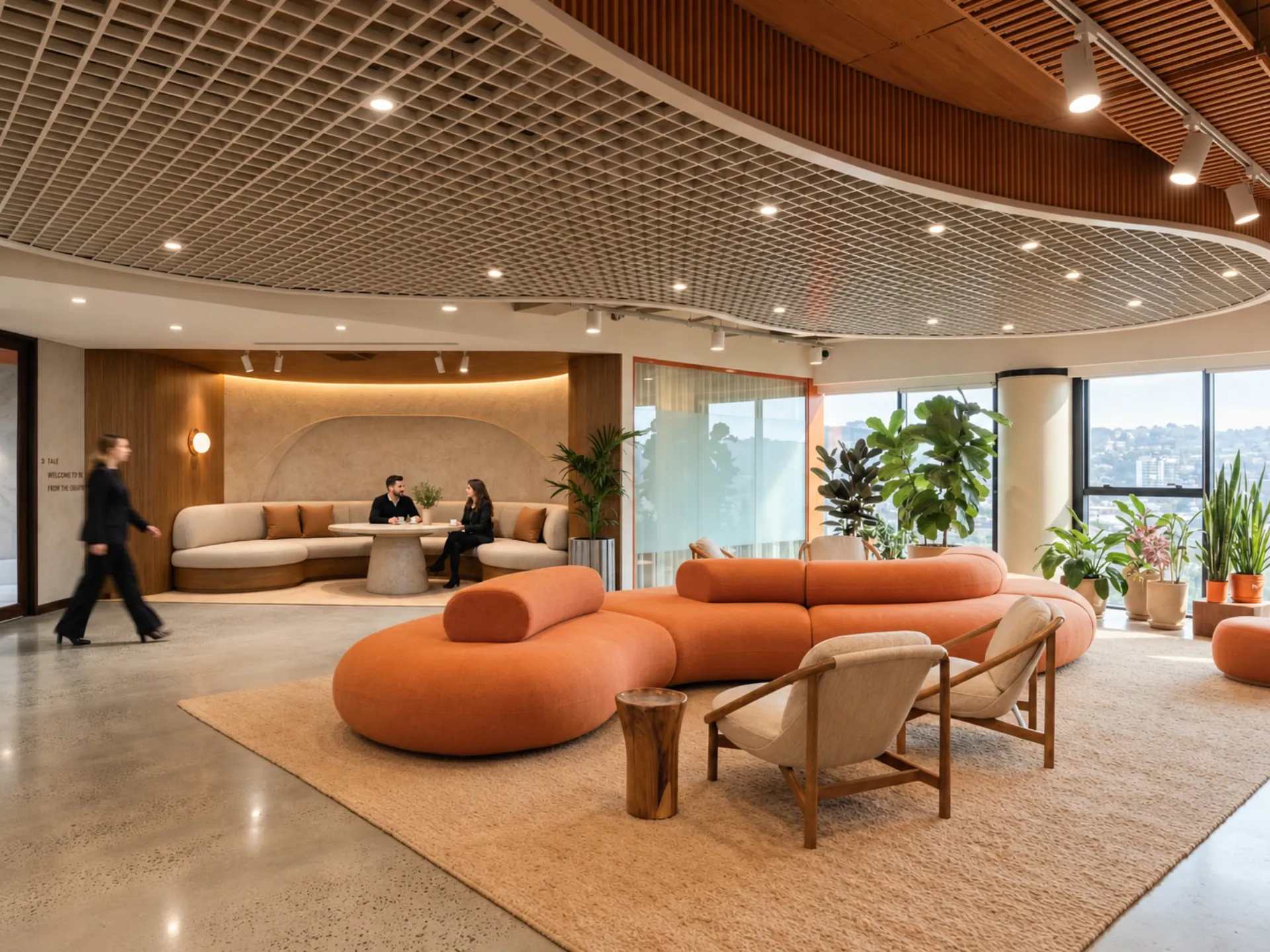
For M&E GCCs in India, the workplace provides a defined starting point. Energy and water consumption, material selection, construction waste, and employee well-being can all be addressed through deliberate design decisions. The opportunity is to make the GCC a measurable part of the organisation’s ESG strategy, with decisions that account for both environmental performance and the people working within it.
05 ESG imperatives for Media and Entertainment GCCs
01. Track & Reduce Controllable Emissions
Challenge: For M&E businesses, a significant share of carbon emissions sits outside direct operational control. Netflix’s environmental disclosures identify Scope 3 emissions as the dominant share of its reported footprint. These emissions extend across the value chain, making them more difficult to manage than consumptions directly within an office.
Solution: The GCC provides a defined starting point for measuring and managing carbon emissions across both fit-out construction and long-term operations.
- Life-cycle assessment (LCA) helps evaluate the environmental impact of materials and construction decisions across relevant stages of a workplace’s life.
- Environmental Product Declarations (EPDs) provide standardised information on product impacts, enabling evidence-based comparison of material options.
At Zyeta, we conduct a comprehensive life cycle assessment at the concept stage through tools like One Click LCA, evaluating space planning, material use, reuse potential and waste management at every stage of the project. Integrated BIM-supported material calculations help minimise off-cuts and scrap, while planned waste segregation enables on-site reuse and recycling.
02. Data-Driven, Resource-Efficient Design
Challenge: M&E GCCs require reliable infrastructure for high-fidelity screens, secure data networks for content IP protection, AI training labs, live-streaming operations and product development. These requirements bring substantial power and cooling loads under one roof.
Solution: LEED certification provides a framework for addressing energy efficiency, water consumption, materials, and waste through coordinated design decisions.
- IoT-enabled sensors and building management systems monitor occupancy, temperature, indoor air quality and energy use, informing the right space utilisation and HVAC needs for both employees and technical infrastructure.
- Efficient lighting, water-saving fixtures and certified material specifications address other sources of consumption.
- Commissioning and post-occupancy audits help establish whether these systems are performing as intended.
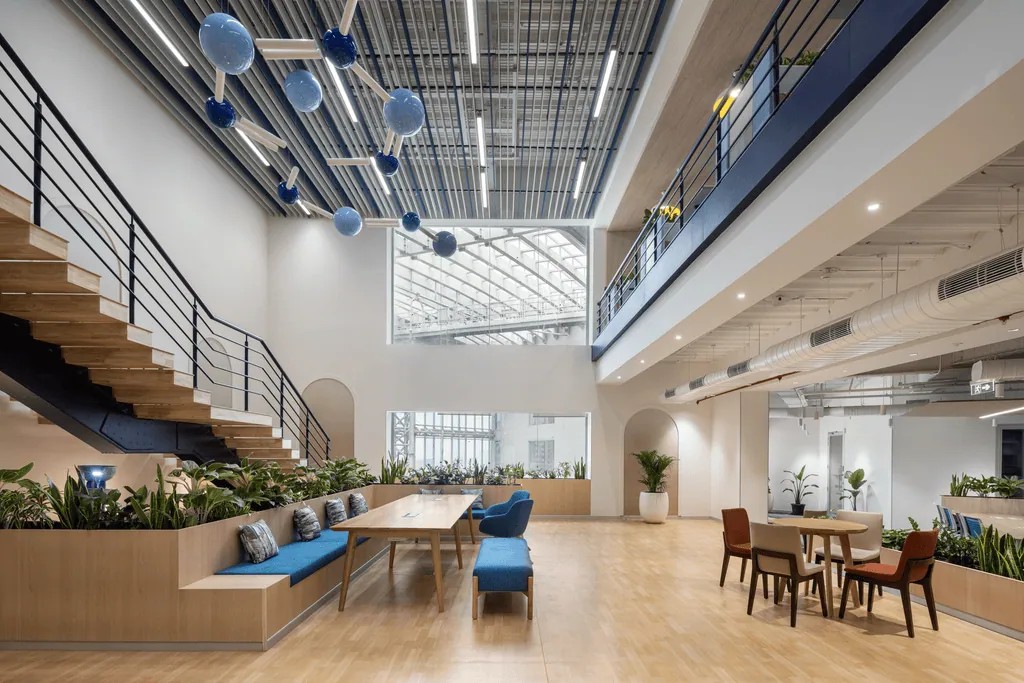
Over 304,000 sq. m. of LEED-certified buildings, delivered by Zyeta
03. Crafting a Sustainable Experience
Challenge: For a content-led business, brand perception is closely connected to the values it communicates. The workplace provides an opportunity to make sustainability commitments visible and experiential rather than relying on dense reports.
Solution: Integrate innovative design solutions that translate ESG commitments into tangible workplace experiences.
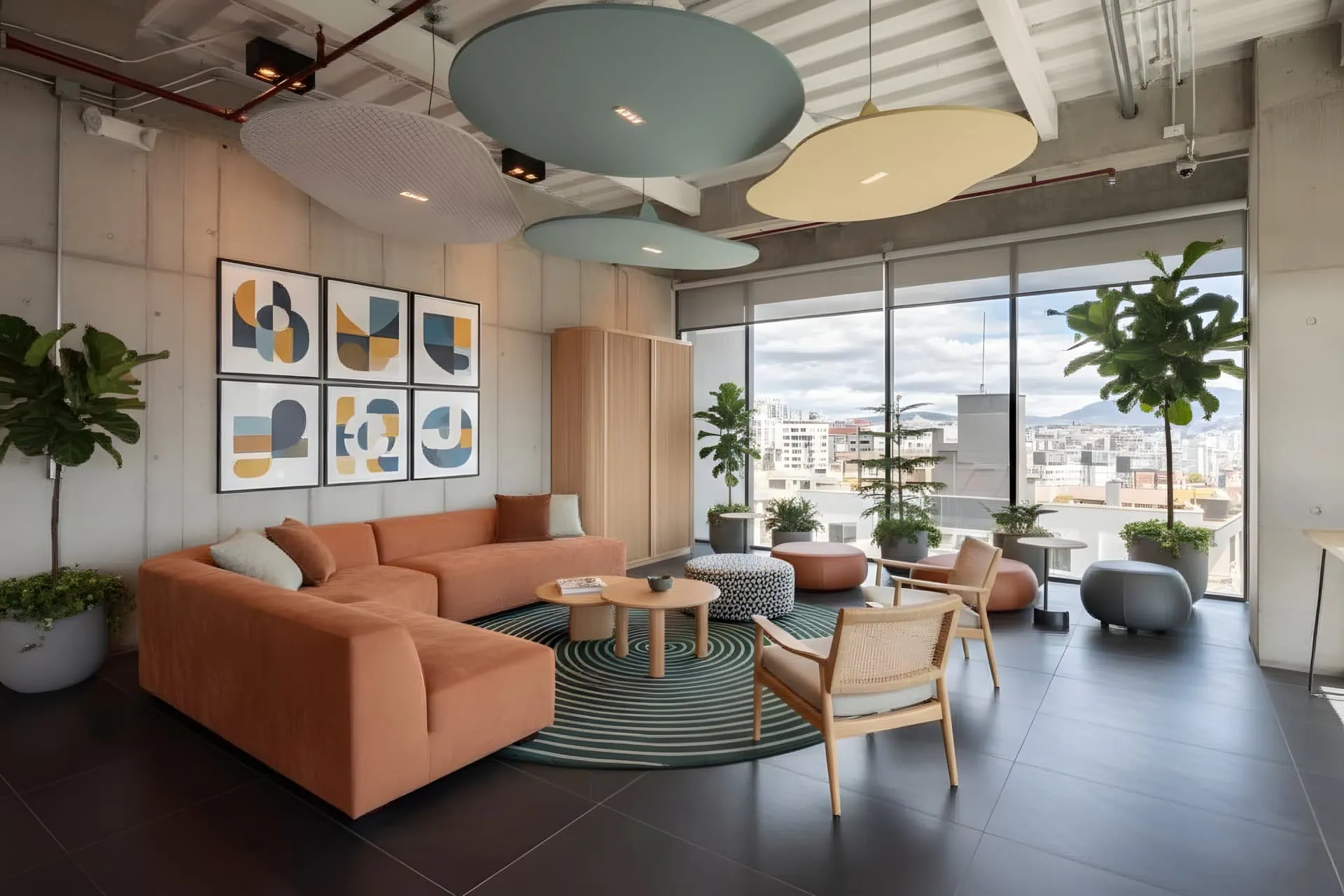
- For M&E GCCs, reception areas, shared spaces, lighting and furniture can communicate environmental priorities while meeting the functional requirements of the workplace.
- Reclaimed, locally sourced materials and artisanal craft can be utilised to create designs that drive environmental performance as well as long-term relevance.
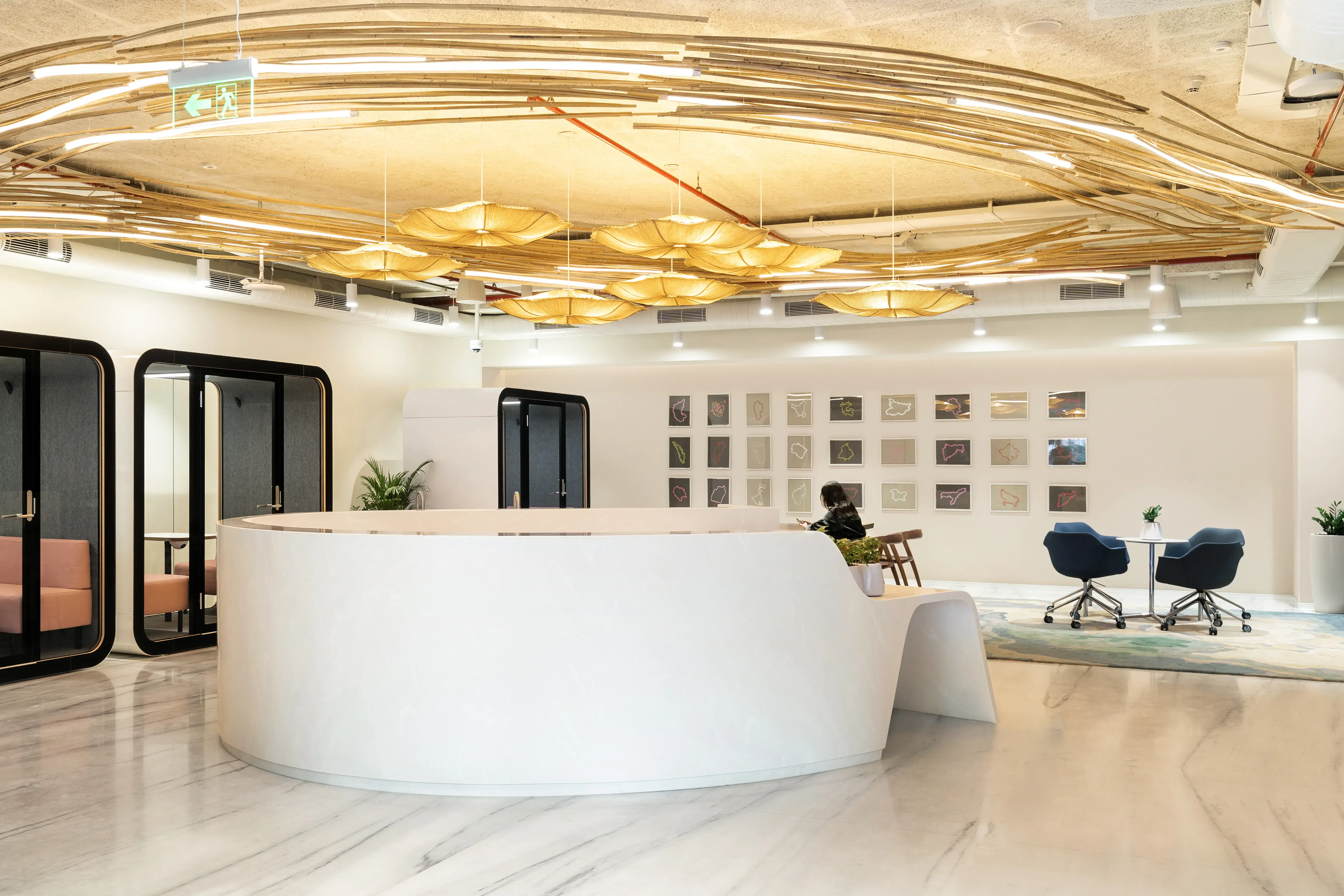
At Financial Services Firm, Bengaluru, Lantana reeds cleared from nearby forests, along with bamboo, cane, and banana fibre, were handcrafted with local artisans to create architectural and lighting elements
04. Balancing Employee Performance With Well-Being
Challenge: M&E GCCs operate across continuous production and distribution cycles. Teams coordinate content reviews, product development, creative production, and global stakeholder discussions across time zones. The workplace needs to support concentrated work, creative output and cross-functional collaboration without compromising either.
Solution: WELL certification provides a framework for addressing occupant health and well-being by analysing indoor air quality, lighting, thermal comfort, and acoustics.
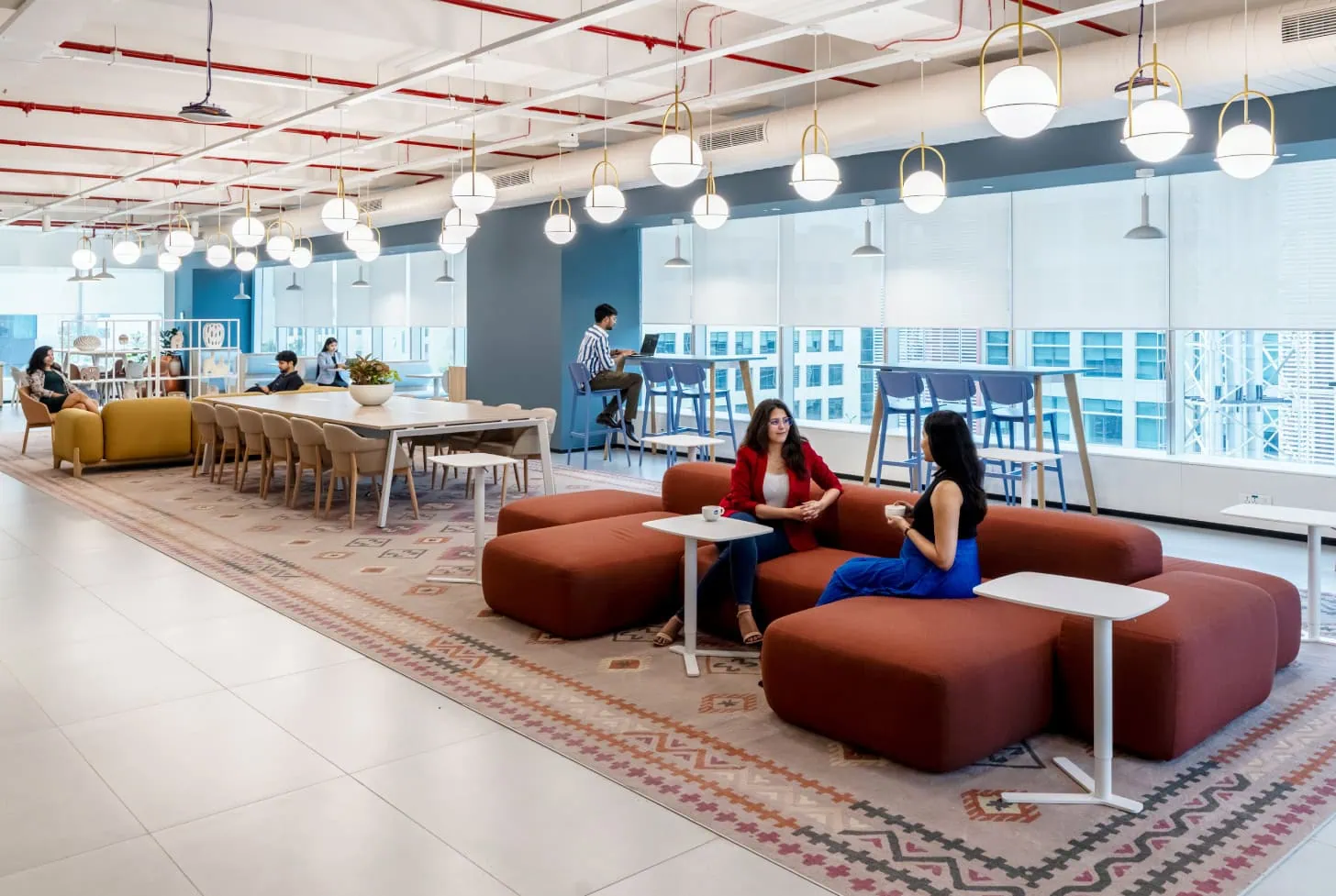
- Spatial planning and workplace strategy establishes the foundation by creating distinct settings for different work modes.
- Low-stimulus, high-focus zones and acoustically controlled workstations support focused work.
- Collaboration spaces and AI-enabled digital infrastructure facilitate cross-functional meeting.
- Circadian-aligned lighting, daylight access and fresh-air provision help maintain comfortable working conditions across extended production cycles.
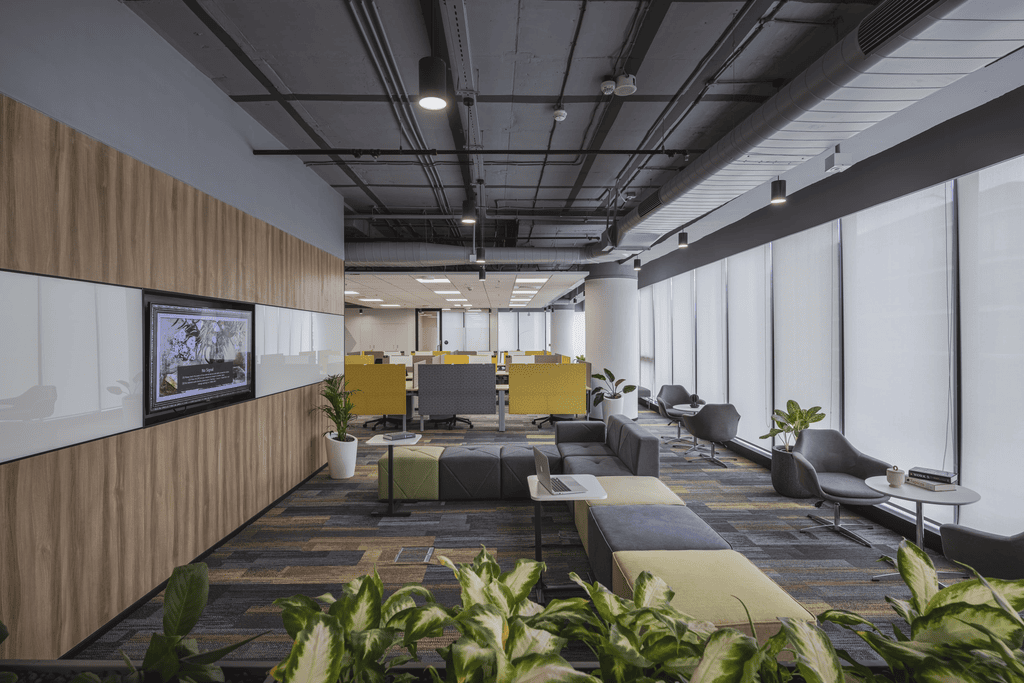
Over 235,000 sq. m. of WELL-certified buildings delivered by Zyeta
05. Cognitive Recovery from Digital Distress
Challenge: Apart from continuous screen exposure across production, M&E teams spend considerable time reviewing content and evaluating digital outputs. ‘Human-in-the-loop’ AI training and content review teams are also often exposed to sensitive content, adversely affecting their mental health.
Solution: Create dedicated ‘zero-tech’ decompression spaces that help teams recover from prolonged screen exposure and emotionally demanding content review.
- Common areas and circulation spaces can deliberately be designed to remain analogue and screen-free, providing a break from digital stimulation.
- Biophilic design principles such as living walls and soundproof acoustic shells playing white noise or nature soundscapes can be incorporated to allow psychological resetting.
How designing for these ESG imperatives drives business growth
- Talent attraction and retention: PwC found that just over 60% of entertainment and media employees planned to change jobs within 12 months. Bengaluru also accounts for around 30% of India’s GCC hiring, especially in the emerging tech sector. In this competitive market, a credible commitment to well-being and responsible operations can strengthen an organisation’s employer proposition.
- Productivity and focus: A study of six WELL-certified offices, co-authored by the International WELL Building Institute, found perceived productivity rising from 80 to 90.
- Lower operating cost: Energy- and water-efficient systems can reduce recurring resource costs. Monitoring makes consumption visible and helps facilities teams identify opportunities for further optimisation.
- Stronger client and partner trust: For organisations working across content, advertising and digital services that cater to a public audience, credible sustainability performance matters to business relationships. The workplace embodies a measurable ESG asset that can be tracked and reported.
Design your ESG-Ready Workplace with Zyeta PURE
For M&E GCCs, ESG needs to be part of the workplace brief from the outset. Material selection, building systems, spatial planning, procurement, and construction all influence the environmental performance of the finished office and the conditions in which employees work.
Through Zyeta PURE, Zyeta provides sustainability consulting and support for LEED and WELL certifications, life-cycle assessment, carbon-conscious construction and post-occupancy audits, integrating sustainability requirements with design, engineering, procurement and project delivery.
We hold ourselves accountable to the same sustainability standards that we commit to deliver for you. Zyeta is EcoVadis-assessed across environment, labour and human rights, ethics, and sustainable procurement. We hold a Silver membership awarded by the U.S Green Building Council.
Ready to plan your ESG-ready Media and Entertainment GCC?
Connect with Zyeta to understand how designing for sustainability can drive measurable business growth.
Connect with Zyeta’s workplace strategy and sustainability experts.
Related Reads:
How Businesses in Singapore Can Future-Proof Their Workplaces Against Scope 3 Emissions?
Part 1 – Built to Last? Rethinking Climate Action Through the Built Environment