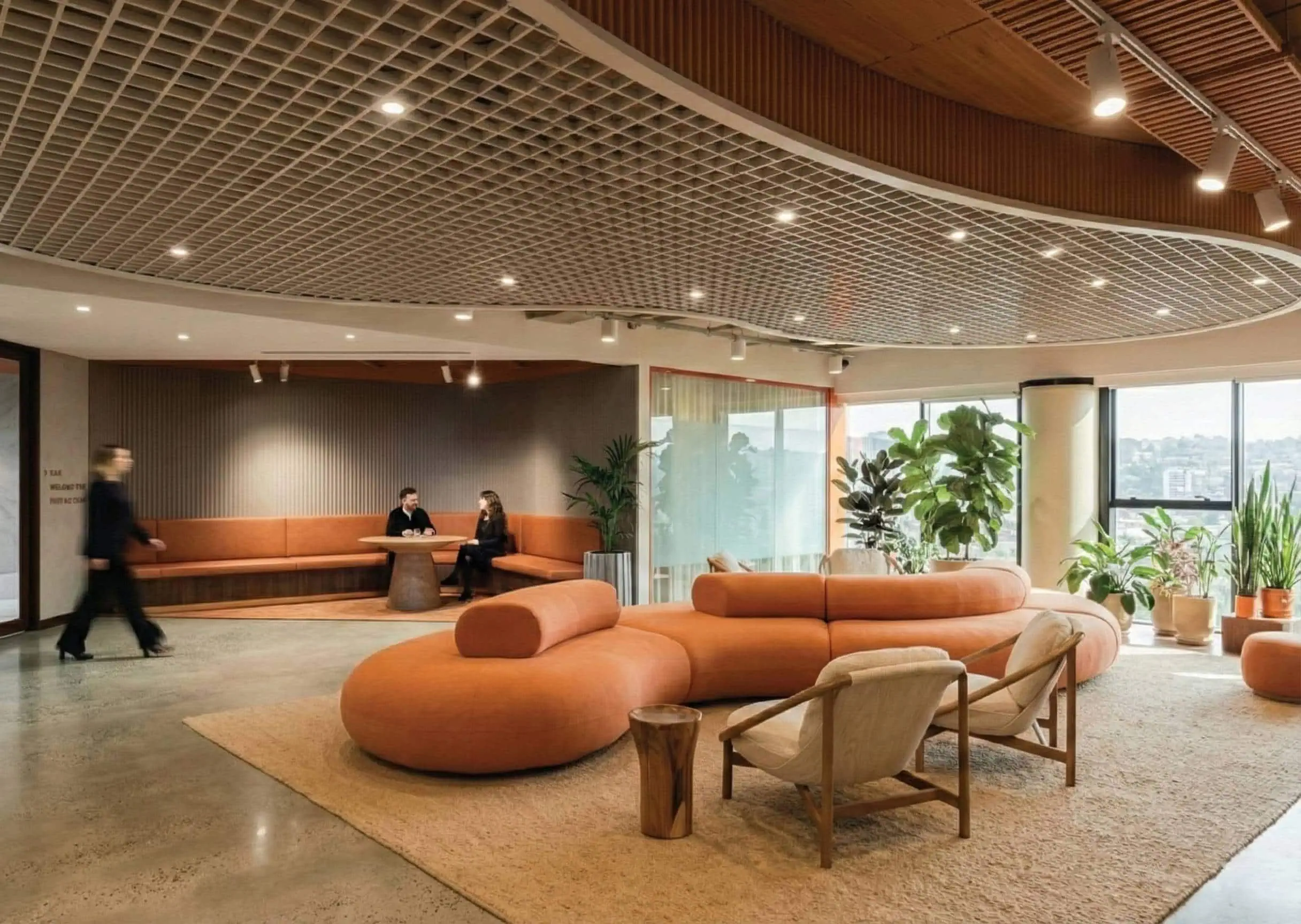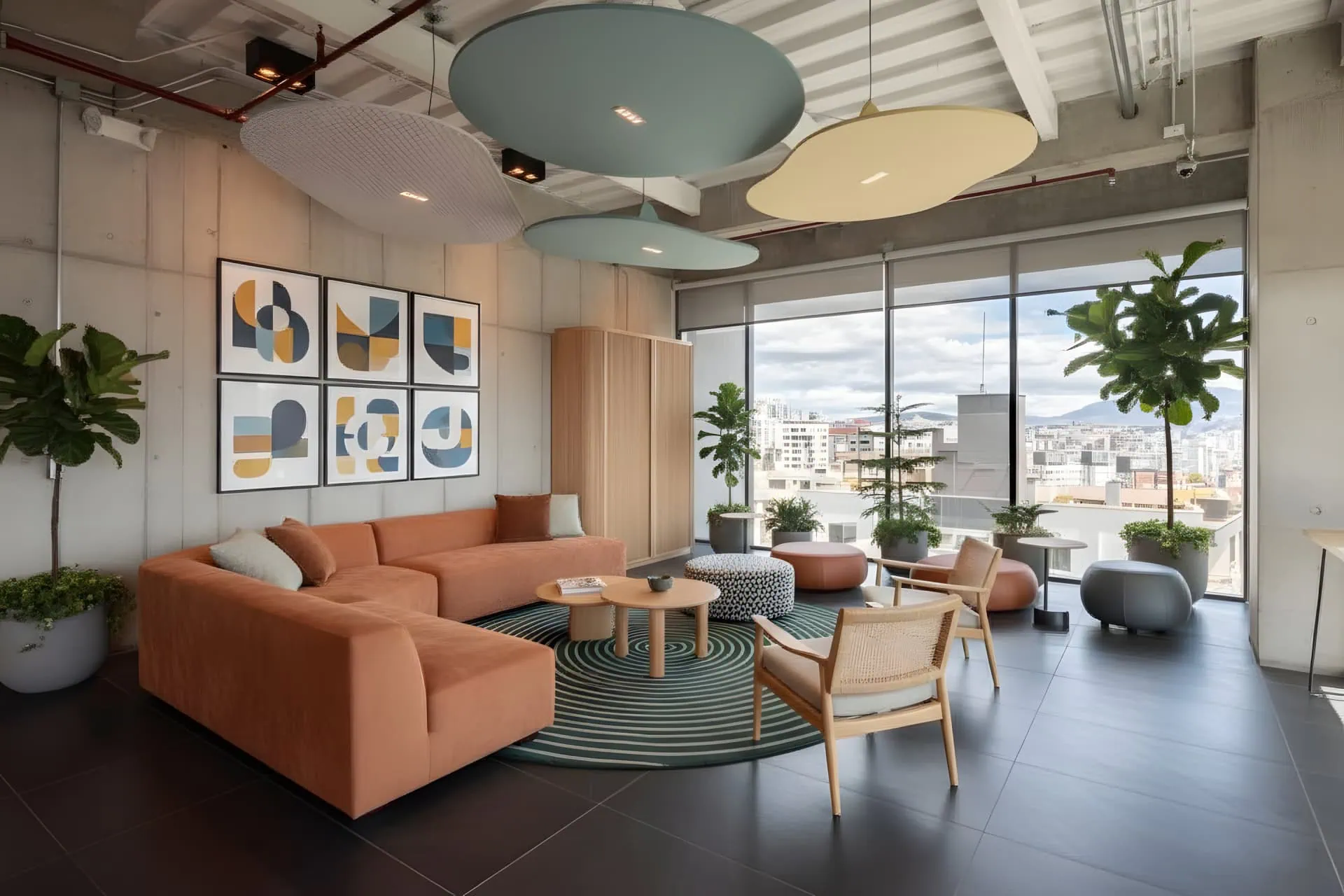
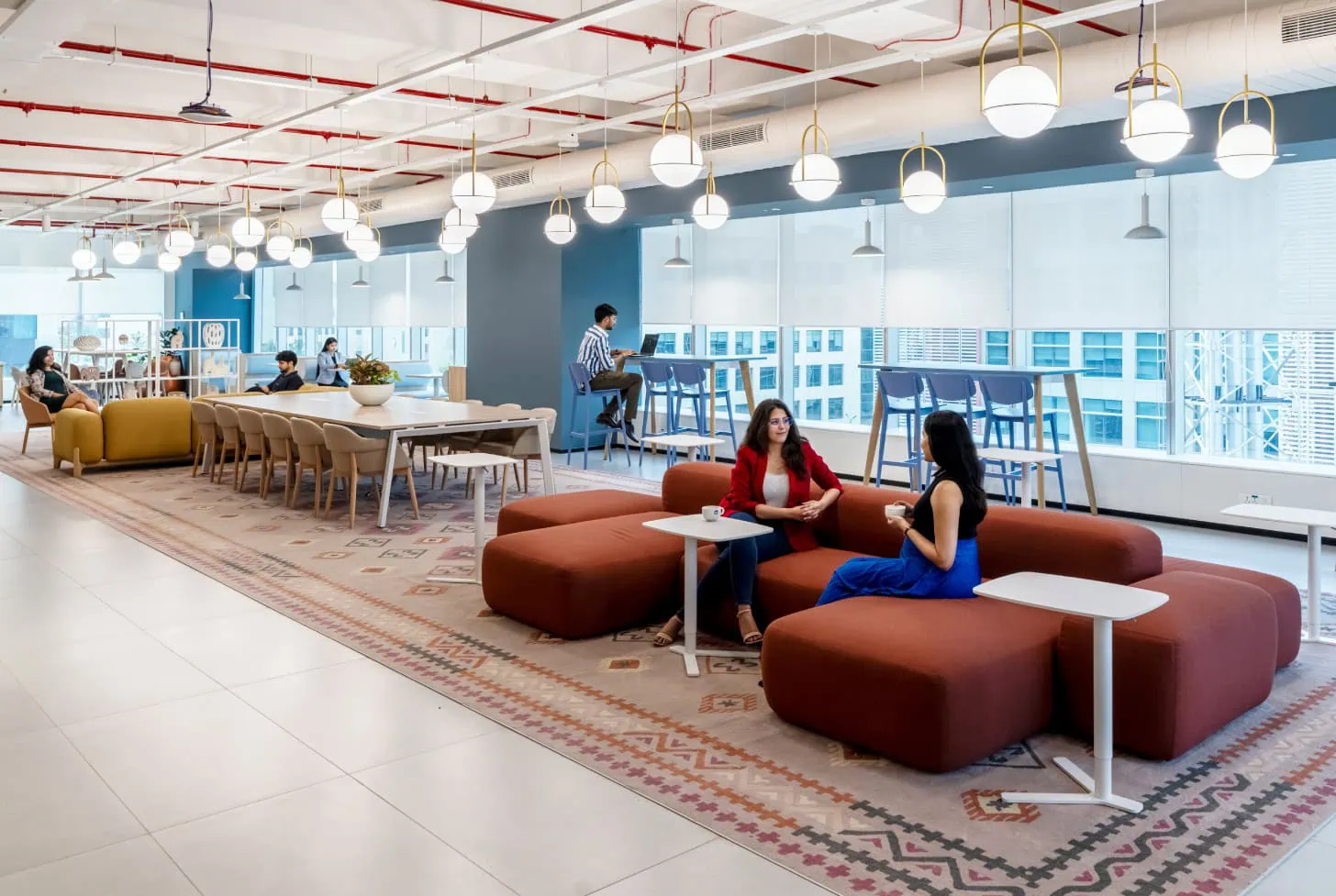
Nearly one in every two square feet of Grade A office space leased in India this year will be leased by a Global Capability Centre (GCC). That’s not a forecast, it’s the current run rate, with GCCs projected to account for 40-50% of India’s Grade A demand in 2026. Every one of those square feet is quietly deciding a carbon number that almost nobody in the transaction is tracking.
Carbon works like concrete, not like paint. Paint can be changed after the fact: a different color, a different finish, applied whenever someone gets around to it. Concrete can’t. Once it’s poured, the shape is set, and everything built afterward has to work around it. A workplace’s carbon footprint behaves the same way. The space plan, the material palette, the structural grid of decisions made in the brief, these pour the shape of the outcome. What happens after that is finishing work. You can specify a lower-carbon chair. You cannot undo an over-built floor plate.
The good news: there are exactly seven design decisions that determine almost all of it, and every one of them happens before construction starts.
The Math Nobody’s Running Early Enough
Buildings account for 30-40% of global annual carbon emissions, and interior fit-outs are the least examined slice of that number, even though fit-outs, unlike a building’s core and shell, are entirely within a single tenant’s control. That control is the opportunity. Analysis of India’s commercial fit-out market shows that circular, low-carbon design strategies can cut embodied carbon by 25-55%, but the range only holds if reuse, right-sizing, and material specification are locked before procurement begins, not retrofitted onto a finished design.
The reason this window matters so much for GCCs specifically is scale. India now hosts more than 2,100 Global Capability Centers generating close to $100 billion in revenue, a number projected to cross 2,500 centers by 2030. Office interiors get replaced roughly every five to seven years. Multiply a compounding carbon decision across that many centers, on that short a cycle, and a design-stage error isn’t a one-time miscalculation. It’s a recurring liability with a fixed renewal date.
Why the Stakes Are Different for a GCC
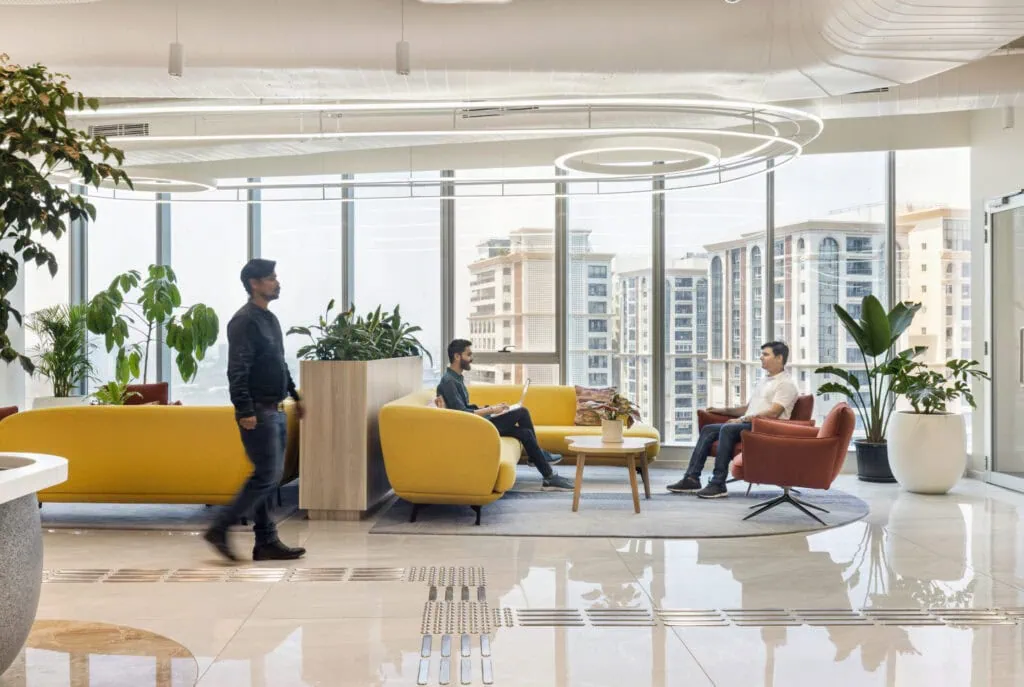
WELL & LEED Platinum Certified GCC | Swiss Giant in Generic Pharmaceuticals and Biosimilars
A commercial tenant’s carbon footprint is a local number. A GCC’s is not. Real estate decisions made in Bengaluru or Hyderabad get consolidated into a parent company’s global ESG disclosure, which means an India center isn’t only signing a lease, it’s contributing a line item to a target the parent has already published to shareholders. Get the design-stage carbon math wrong in India, and the correction shows up in a boardroom in London or Chicago.
There’s a talent dimension layered on top. GCCs have stopped competing only on cost arbitrage; they’re competing for the same engineering and analytics talent as any global tech company, and workplace quality is part of that pitch. A GCC brief was never really about square footage. It’s four negotiations happening in one document: talent, brand, governance, and carbon.
What GCC Leaders and Global Sustainability Heads Actually Need Solved
Strip the diplomacy away, and these are the real questions sitting between a GCC real estate lead and a global sustainability head:
How do we hit carbon targets without adding time to delivery. Carbon strategy has to run inside the existing design timeline, not extend it.
How do we keep the workplace premium without inflating cost. The spend has to be precise and justified, not open-ended.
How do we prove the claim, not just make it. Global disclosure needs numbers a sustainability team can defend, not adjectives a design team can pitch.
How do we serve talent, brand, and ESG through one decision, not three. These have historically been three separate conversations with three separate owners.
How do we do this consistently across a multi-city, multi-country portfolio. A standard that works in Bengaluru has to hold in Hyderabad, Singapore, and Manila without reinventing the approach each time.
07 Design Strategies to Build a Carbon-Neutral GCC Office
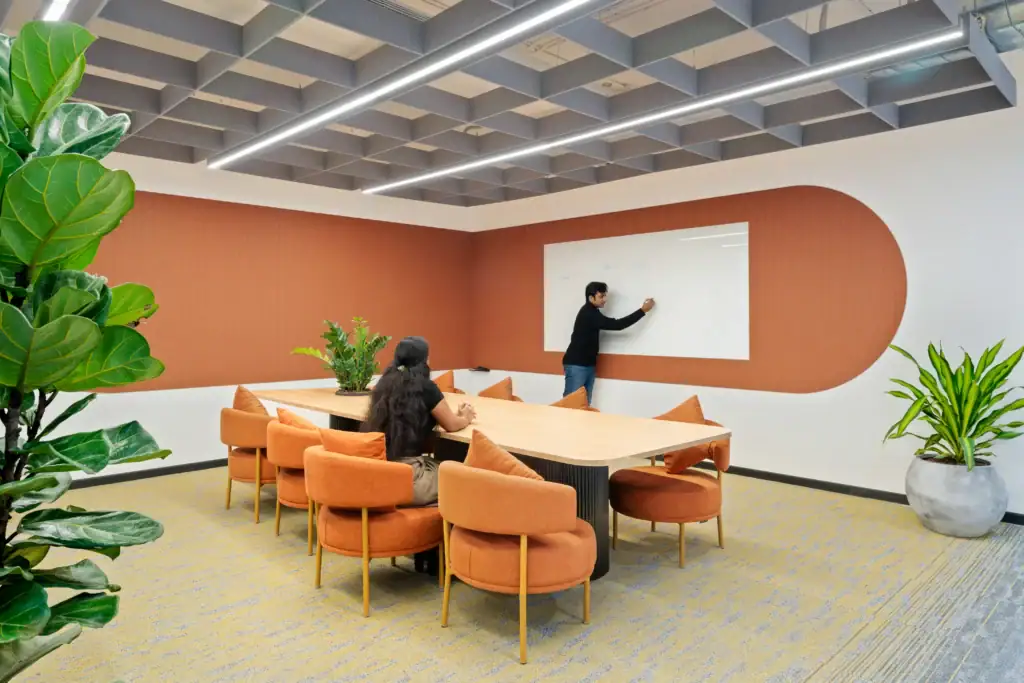
LEED Gold- certified GCC | IFF Global Business Services Center
01. Set a carbon baseline at concept stage.
Identify the fit-out’s scope and its major carbon hotspots before drawings progress. A number you haven’t measured is a number you can’t defend later, to anyone: not your design team, not your CFO, not your parent company’s ESG desk.
02. Audit for reuse before specifying anything new.
Furniture, partitions, and fixtures from a prior fit-out or another portfolio asset get reviewed first. This single step is often the highest-carbon-return move on the entire list, and it’s the one most briefs skip because “what can we keep” doesn’t feel like progress the way “what can we buy” does.
03. Size space against real occupancy, not legacy headcount.
Every square foot built without a genuine occupancy need is embodied carbon with no return on it, a cost the balance sheet never recovers.
04. Design for adaptability, not just for day one.
A layout built to absorb hybrid patterns and headcount shifts without a full re-fit-out avoids triggering a fresh emissions event every time the workforce model changes.
05. Specify materials against Environmental Product Declarations, not adjectives.
An EPD is a product’s actual life-cycle carbon data, independently verified. “Sustainable material” without one is marketing copy standing in for a fact.
06. Design for disassembly, not demolition.
Circularity, reuse, take-back, end-of-life recovery, has to be engineered in before the first fit-out cycle ends, or the five-to-seven-year replace-and-waste pattern simply repeats itself, generation after generation of interiors.
07. Model carbon inside BIM, and map WELL and LEED ID+C in the same pass.
Carbon modelling inside the BIM workflow tests every material and layout option against its footprint before approval, not after handover, when the only option left is regret. This matters more right now than it has before: LEED v5 has converted embodied carbon assessment from an optional credit into a mandatory prerequisite, with roughly half of all available credits now tied to decarbonization.
Documentation for that has to be built in from schematic stage, alongside WELL’s occupant-health parameters (air quality, daylight, acoustics, thermal comfort), because a carbon target and a healthy workplace were never actually competing goals.
What Changes When the Sequence Is Right
Run these seven strategies at the design stage, and the tensions from earlier stop being tensions. Speed holds, because carbon modelling runs concurrently with design development instead of trailing behind it. Cost becomes a known quantity: circular, low-carbon fit-outs typically carry a 10-15% premium upfront, recovered over 5-10 years through extended asset life and fewer replacement cycles.
The evidence gap closes on its own, because EPDs and LCA data are the evidence, not a claim standing in for one. And WELL, LEED, and carbon stop being three parallel scorecards, because the decision that makes a workplace low-carbon and the decision that makes it good to work in were always the same decision, made at the same table.
The Conversation to Have Before the Brief Is Final
None of these seven strategies work if they arrive after the design is locked. They work because they happen at the table where the brief is still being written, which is exactly why the right design and build partner matters as much as the strategy itself.
This isn’t theoretical for the GCCs already building this way in Hyderabad. IFF’s GCC is LEED Gold certified. Sandoz’s Hyderabad centre holds both WELL and LEED Platinum. Carrier’s Hyderabad centre carries the same dual WELL and LEED Platinum standard. Three different GCCs, three different sectors, the same outcome: certification followed naturally because the carbon and health decisions were made at the design stage, not chased afterward.
If you’re setting up or scaling a GCC in India, this is the conversation to have with your design partner before the brief is finalized, not after.