

Something fundamental has shifted in how corporate occupiers in Singapore think about their office space. What once lived in the facilities team’s spreadsheet: fit-out materials, furniture procurement, contractor choices, now lives in your sustainability report. Singapore Scope 3 emissions reporting is no longer a future obligation. For Straits Times Index (STI) constituents, it is mandatory from FY2026, and the clock is already running.
This is about the complete reconfiguration of how workplace decisions get made, and what they cost if they’re made wrong.
The Regulatory Stack Is Taller Than You Think
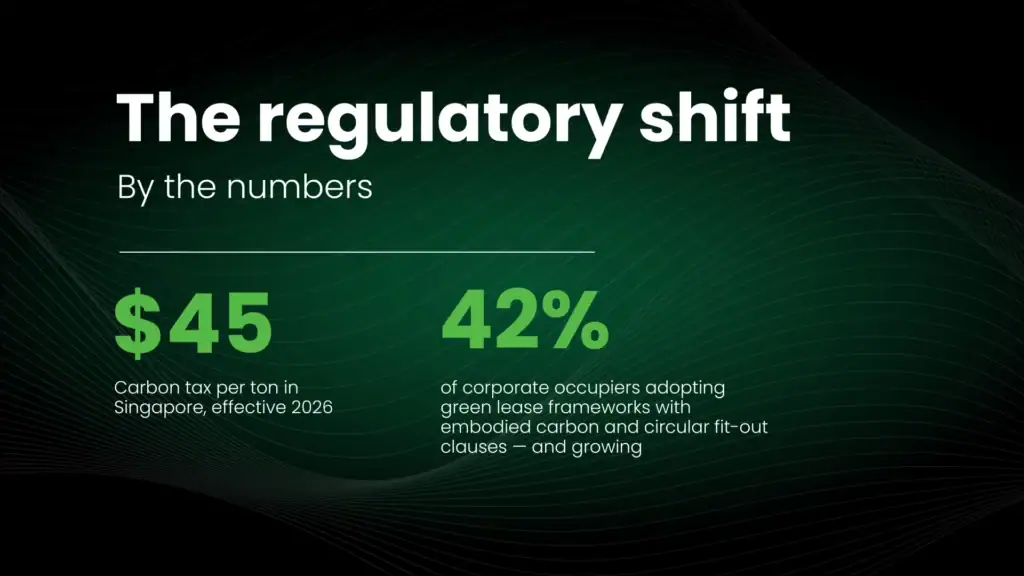
Most conversations about Singapore’s sustainability regulations start and stop at the carbon tax. That number alone is significant: from S$5 per ton in 2019, the rate has escalated to S$25 in 2024 and S$45 per ton effective January 2026 — with the government targeting S$50–80 per ton by 2030. For commercial buildings, this isn’t abstract. Buildings account for over 20% of Singapore’s total carbon emissions, and rising energy costs flow directly into occupancy costs for every corporate tenant.
But the carbon tax is only the first layer.
SGX-listed companies, particularly STI constituents in sectors like materials and buildings, now face mandatory Scope 3 emissions disclosure from FY2026, under ACRA and SGX RegCo’s ISSB-aligned climate reporting framework. Scope 3 means indirect emissions: the carbon embedded in your supply chain, your procurement choices, your contractors, and critically, the materials and systems installed in the offices you occupy. Your fit-out is now a financial disclosure item.
Simultaneously, the BCA Green Mark for Interiors (GMI) scheme, effective November 2025, creates a unified sustainability certification standard that directly assesses embodied carbon in interior materials, circular fit-out design, and energy-efficient operations. For the first time, a single integrated standard governs everything from flooring and ceiling systems to furniture procurement and how your space handles waste at end-of-life.
These three instruments: the carbon tax, SGX Scope 3 mandates, and the GMI scheme, don’t operate in isolation. They form a regulatory stack that now sits squarely on top of every workplace project in Singapore.
What This Means for Business Leaders and Portfolio Managers?
Here is the practical reality for workplace and sustainability leaders managing corporate real estate in Singapore.
Fit-out decisions are now reporting decisions.
The materials your design team specifies — the partitioning system, the raised access floor, the ceiling tiles, the furniture — all carry embodied carbon. Under the new GMI framework and Scope 3 accounting, that carbon is traceable, measurable, and increasingly, reportable. A conventional fit-out approach that makes no distinction between a low-carbon and high-carbon specification is a liability in your next annual report.
Your lease is changing whether you’re ready or not.
Research by JLL found that 42% of corporate occupiers have already adopted green leases, and another 43% planned to follow by 2025. Of sustainability professionals surveyed across Asia Pacific, 65% believed green leases will replace conventional leases entirely. These aren’t aspirational projections anymore — they describe the market you’re negotiating in right now. Green lease clauses covering embodied carbon, circular fit-out standards, and sustainability data sharing between landlord and tenant are accelerating precisely because they help both parties meet their disclosure obligations.
The procurement chain is under scrutiny.
Multinational occupiers with science-based targets (SBTi) and CDP reporting commitments are increasingly requiring verified Scope 3 data from their landlords and fit-out partners. Building owners who can provide this data have a material advantage in lease negotiations. Fit-out partners who can’t track and report embodied carbon are becoming a compliance risk, not a vendor of choice.
Green-certified space is scarce, and getting scarcer.
According to a recent study, Green Mark-certified buildings in Singapore’s CBD command occupancy rates 2.5–4% higher than non-certified stock and rents up to 12% higher at Platinum certification. With 83% of corporate occupiers in Singapore targeting 100% green-certified portfolios by 2030 (JLL), demand is structurally outpacing supply. Organizations that secure fit-outs with strong sustainability credentials today are locking in competitive positioning at a time when the pool is narrowing.
The New Design Mandate: From Aesthetic to Accountable
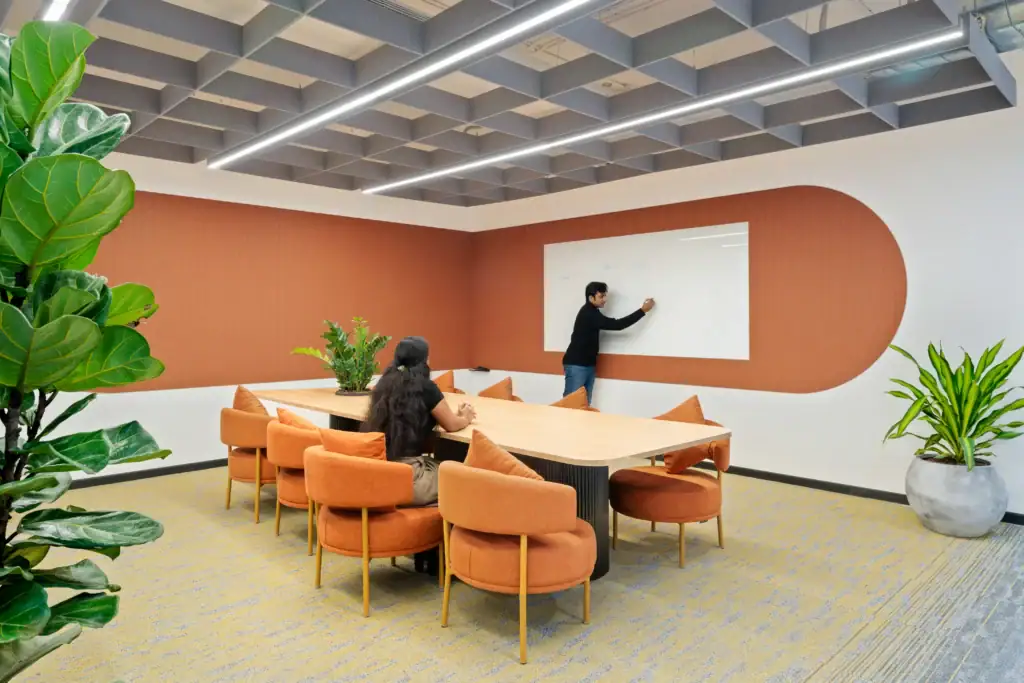
IFF Global Business Services, Hyderabad | LEED-Gold Certified | Designed & Built by Zyeta
The question workplace leaders are now asking isn’t “does this office look good?” It’s “can this office be reported on?” That shift defines the new design mandate for Singapore.
Embodied carbon tracking starts in the design brief. Under the Singapore Building Carbon Calculator — referenced directly in the GMI framework — every major material category carries a carbon coefficient. A design team that isn’t specifying materials with Environmental Product Declarations (EPDs) is producing a brief that will create compliance gaps downstream.
Embodied carbon workplace design that integrates low-carbon materials, adaptive reuse of existing installations, and demountable systems doesn’t just reduce your carbon footprint — it generates the data trail your Scope 3 report depends on.
Circular fit-out principles move from nice-to-have to structurally necessary. The GMI scheme explicitly awards points for preserving existing flooring, ceiling systems, and furniture rather than replacing them. This creates a direct alignment between circular design strategy and certification outcomes — and a direct cost benefit, since materials retained are materials not purchased. More importantly, circular procurement reduces the embodied carbon that needs to be counted, not just offset.
BCA Green Mark Interiors certification is rapidly becoming a baseline expectation rather than a differentiator. For organizations signing new leases in 2025–2026, GMI certification of their fit-out is the clearest way to demonstrate to landlords, investors, and regulators that their occupied space meets Singapore’s built environment sustainability ambitions. The scheme’s alignment with the SGX reporting framework means that GMI data and Scope 3 reporting data share a common foundation — one data infrastructure serving multiple obligations.
What Forward-Thinking Organizations Are Already Doing

The organizations that are managing this well aren’t waiting for penalty structures to mature. They are:
Integrating carbon tracking into their workplace brief from day one — treating embodied carbon as a design constraint alongside floor plate efficiency and construction budget. They are insisting on EPD-backed material specifications and requiring their fit-out partners to produce lifecycle carbon assessments as a project deliverable, not an afterthought.
They are renegotiating lease terms to include sustainability data-sharing clauses, giving them visibility into building performance data they need for Scope 3 disclosure while demonstrating ESG accountability to their boards and investors.
They are treating fit-out not as a one-time capital event but as a circular asset lifecycle — designing for disassembly, building furniture and partition systems that can be returned to the supply chain, and maintaining a carbon inventory across their portfolio that is audit-ready for SGX reporting.
And critically, they are choosing workplace design and build partners who bring sustainability expertise as a core competency — not as a bolt-on service offered under regulatory pressure.
How Zyeta Helps You Build What Comes Next
At Zyeta, Scope 3 emissions reporting and green lease compliance are more than frameworks we’re learning about. They’re requirements we design to, brief against, and deliver within, for corporate occupiers across the APAC region.
Our approach integrates embodied carbon tracking from the earliest design stages, and produces the documentation your sustainability team needs to satisfy both internal ESG governance and external regulatory disclosure. We understand that your workplace project is also a reporting commitment, and we bring strategic and technical depth to make both outcomes work.
Whether you are approaching a new lease, planning a fit-out in an existing space, or rethinking a portfolio-level sustainability strategy, the regulatory environment in Singapore has fundamentally changed what a credible workplace partner looks like.
Connect with our Singapore workplace experts to future-proof your next fit-out .
Sources
National Climate Change Secretariat, Singapore (2026). Carbon Tax. Singapore Government. https://www.nccs.gov.sg/singapores-climate-action/mitigation-efforts/carbontax/
Ministry of Sustainability and the Environment, Singapore (2026). Carbon Tax FAQs. Singapore Government. https://www.mse.gov.sg/resources/faq/
Accounting and Corporate Regulatory Authority (ACRA) & Singapore Exchange Regulation (SGX RegCo) (2025). Extended Timelines for Climate Reporting Requirements. SGX Group. https://www.allenandgledhill.com/sg/publication/articles/31136/acra-and-sgx-regco-extend-timelines-for-most-climate-reporting-requirements
Building and Construction Authority (BCA) & Singapore Green Building Council (SGBC) (2025). Green Mark for Interiors (GMI) Scheme. https://gm-interiors.sgbc.online/
JLL Asia Pacific (2024). The Green Tipping Point: Low Carbon Space Demand in Asia Pacific. https://www.jll.com.sg/en/trends-and-insights/research/the-green-tipping-point
Lexology / JLL (2023). The What, Why, and How of Green Leases in Singapore. https://www.lexology.com/library/detail.aspx?g=d4adf8db-5bd3-4d9b-a6c4-5496cab230b1
Upcyclea (2026). Embodied Carbon Champions: How Singapore’s Built Environment Leaders Are Rewriting the Carbon Calculus. https://upcyclea.com/sg/embodied-carbon-champions-how-singapores-built-environment-leaders-are-rewriting-the-carbon-calculus/
Climate Impact X (2026). Singapore Carbon Tax: A Guide for Corporates. https://climateimpactx.com/singapore-carbon-tax/
Zevero (2026). BCA Green Mark Certification: Singapore Green Buildings and ESG Reporting. https://www.zevero.earth/blog/bca-green-mark-certification.
Related Reads:
How Businesses in Singapore Can Future-Proof Their Workplaces Against Scope 3 Emissions?
07 Strategic Workplace Design Imperatives for India’s Evolving GCCs