What does a business-ready AI GCC workplace look like?
Global Capability Centers (GCCs) in Asia are building the platforms, models and products that shape their parent organizations’ growth. For the leaders setting up these hubs, AI GCC workplace strategy in Asia has to deliver an efficient workplace on day one and a hub that is ready for business from the first review. Desk counts and generic meeting rooms cannot do that.
AI and product teams work in several modes within a single day: uninterrupted coding, debugging, peer review, product decisions, demonstrations and cross-border calls. A workplace built around assigned seats cannot support that rhythm.
Global office utilization averaged 54% in 2025 against an average organizational target of 79%, according to JLL’s Global Occupancy Planning Benchmark Report. The gap points to a mix problem more than a space problem. Static allocation puts the wrong kind of space in the wrong proportion.
How do GCCs in Asia set up efficient, business-ready product and AI development hubs? By planning around work modes instead of desk counts, setting an AV standard at concept stage, and using one global kit of parts calibrated for India, Singapore and Taiwan. The priority behind all three is spatial precision.
Why the GCC mandate calls for a different workplace?
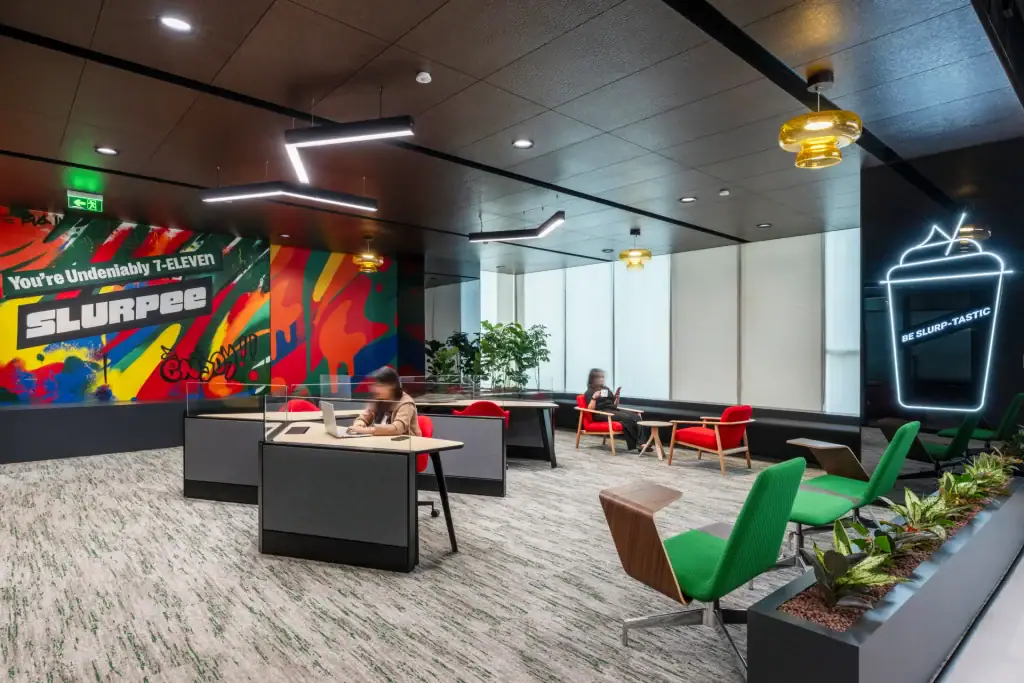
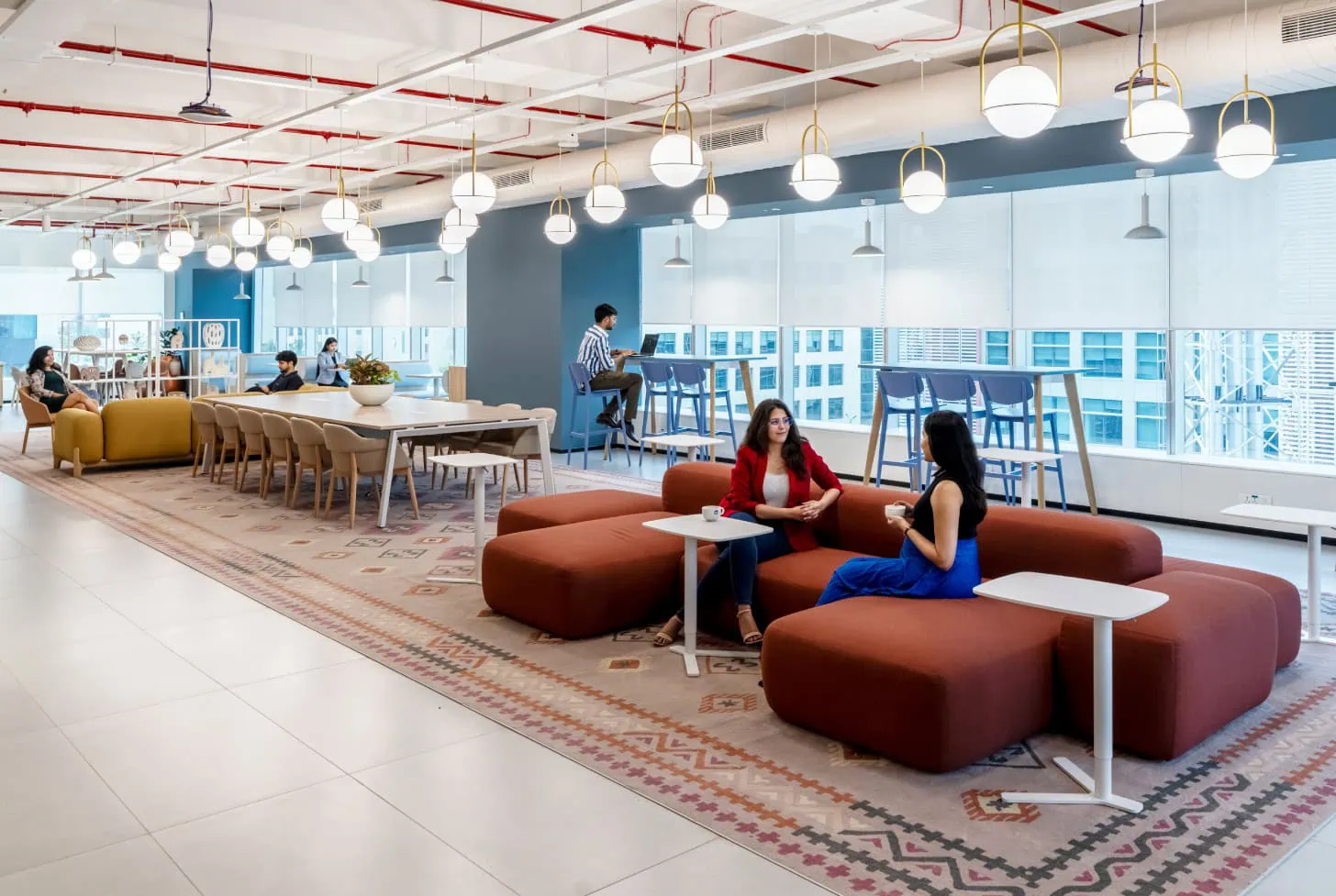
Image Courtesy: 7 Eleven GSC, Bengaluru | Cars of 7 Eleven
India offers the clearest evidence. Deloitte’s FY25 analysis counted more than 1,800 GCCs employing approximately 2.16 million professionals. EY’s 2025 GCC Pulse Survey found that 83% of GCCs were investing in GenAI and 58% in agentic AI, with a further 29% planning to invest within a year.
The EY figures are survey results, and they matter because they describe the work taking place inside the building. Teams review models, test workflows, protect intellectual property and make product decisions with global stakeholders. GCC leaders need an office that works as a technical platform, with desks as one component of it.
1 strategy, 3 market realities
The same product studio does not translate evenly across Asia. Each market applies a different pressure, and the workplace has to respond to it.
India: Scale and repeatability
India is a product-engineering ecosystem with deep talent, spread across Bengaluru, Hyderabad, Chennai, Pune, Mumbai and emerging Tier-II cities. GCC leaders here need a workplace kit that repeats well across sites and still delivers acoustic focus, project-based collaboration and strong technical infrastructure. Modular neighborhoods and swing capacity keep growth from forcing a refit.
Singapore: Premium efficiency and talent
Real estate is expensive and talent is mobile. Singapore’s Economic Development Board reports that 82% of workers want additional training to use AI at work. Compact planning, executive-ready hybrid rooms and visible learning spaces give these teams efficiency and a reason to stay.
Taiwan: Secure hardware-software collaboration
Taiwan’s strength lies in how semiconductor, hardware and software ecosystems connect. AI teams there often work across all three, which raises the importance of IP security, acoustic control, resilient power and specialist collaboration. Secure project zones and resilient building systems answer those needs.
What Media and Entertainment shows about workplace performance?
The clearest proof of these pressures sits in a sector where the quality of a review is easy to see. Media and Entertainment (M&E) makes spatial and AV performance visible. India has close to 50 M&E capability centers, according to the Ministry of Information & Broadcasting, supporting localization, content operations, audience insights and immersive media. Their teams depend on controlled review rooms, high-fidelity sound and color-accurate displays.
AI product teams share the same operating rhythm. They review models where M&E teams review content, and both need reliable technology, concentration and clear decisions across locations.
4 design moves that make a hub efficient and business-ready
1. Plan by work mode, not headcount
Traditional planning starts with departments, reporting lines and assigned seats. AI and product teams need planning that starts with activities.
A typical team needs:
- Deep-focus settings for coding, research and model development
- Project neighborhoods for cross-functional work
- Huddle rooms for debugging and technical problem-solving
- Review theaters for product, model and stakeholder demonstrations
- Secure zones for sensitive data and intellectual property
- Learning areas for mentoring, upskilling and knowledge exchange
A workplace can show moderate desk utilization and still run short of focus rooms, review spaces or project settings. That is why utilization needs to be read by space type, with total floor occupancy as a secondary view.
Action: Run a 2-4 week activity and occupancy study before the floor plate is final. Track peak and average occupancy, focus-room demand, meeting patterns, team clustering, cross-functional interaction and day-of-week variation. Some AI and product teams may start with 30% to 40% of the floor as studio space, but that figure is a hypothesis to test against the organization’s actual workflow, not a universal ratio. Let the right mix emerge from the team’s operating model.
Measure: Utilization by setting, focus-room and review-room demand, focus-room dwell time and employee-reported ability to concentrate.
2. Treat AV as product infrastructure
For AI and product teams, AV supports model reviews, demos, rendering walkthroughs, cross-border design decisions and technical collaboration. It belongs in the concept stage, with a minimum standard defined for every collaboration environment:
- Low-latency connectivity and multi-camera capability
- High-quality microphones and speakers
- Large interactive displays and secure screen-sharing
- Remote-participant visibility, plus recording and playback
- Acoustic treatment and controlled lighting
- Cybersecurity coordination from day one
M&E teams add high-fidelity audio, color-accurate displays and secure media review.
The practical test is simple. Can a team in Bengaluru lead a product review with colleagues in Singapore, Taipei or a global headquarters without the remote participants becoming passive observers? Remote-participant equity is a design requirement for any hub that runs on cross-border decisions.
Action: Set a minimum AV standard at concept stage for collaboration rooms, project rooms, review theaters, executive rooms and training and demonstration spaces.
Measure: AV failure rate, time lost to technical issues, remote-participant satisfaction, reviews completed without relocating and the share of spaces meeting the standard.
3. Use one global kit of parts with local calibration
Global consistency helps GCC portfolios control quality, cost and delivery. A single universal layout will not perform equally well in India, Singapore and Taiwan. A regional AI Product Studio kit gives leaders a common base:
- Focus rooms and project neighborhoods
- Review theaters and war rooms
- Learning spaces and informal collaboration areas
- Wellness micro-zones and secure project areas
- Demonstration and showcase spaces
The performance standard stays constant while proportions shift by market. India’s kit leans on modularity, expansion capacity and repeatable delivery. Singapore’s leans on efficient floor plates, premium experience and learning infrastructure. Taiwan’s leans on security, acoustic control, resilience and hardware-software adjacency.
Local calibration should begin early. Regulatory requirements, accessibility, fire and life-safety rules, cultural patterns and procurement conditions can all reshape the final solution.
Action: Write global performance requirements, then layer in local code and regulatory filters, accessibility requirements, cultural and operational adaptations and a regional material and procurement strategy.
Measure: Share of sites using the standard, variance from approved cost and program, time to deploy a new site and post-occupancy performance across markets.
4. Design for volatility and talent attraction
AI teams grow quickly, reorganize around new products and change priorities within a short period. A workplace that performs well under only one headcount scenario becomes expensive to operate. Planning for volatility calls for:
- Demountable partitions and modular furniture
- Distributed power and data
- Convertible project rooms and flexible project neighborhoods
- Expansion-ready floor plates
- Swing capacity backed by credible growth scenarios
- Technology-enabled demonstration areas
A 15% to 20% flexible capacity allowance may suit some high-growth environments, but it is a hypothesis for each client to test, not a universal rule.
The workplace is also a talent asset. Scarce AI professionals weigh more than compensation. They notice whether the environment supports concentration, learning, collaboration, technical credibility and professional identity.
Action: Model three scenarios: the base operating model, a 12- to 18-month growth case and a project surge or reorganization. Confirm the flexible capacity requirement only after testing all three.
Measure: Growth absorbed without a major refit, time to reconfigure a project zone, cost per seat added, employee retention and workplace experience.
The next GCC advantage is spatial
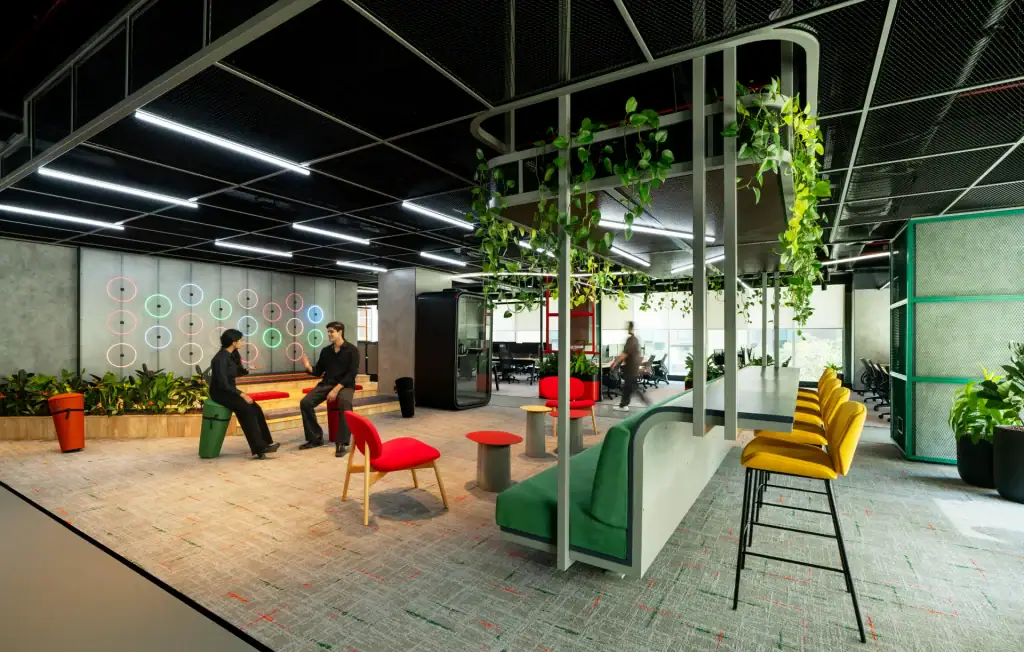
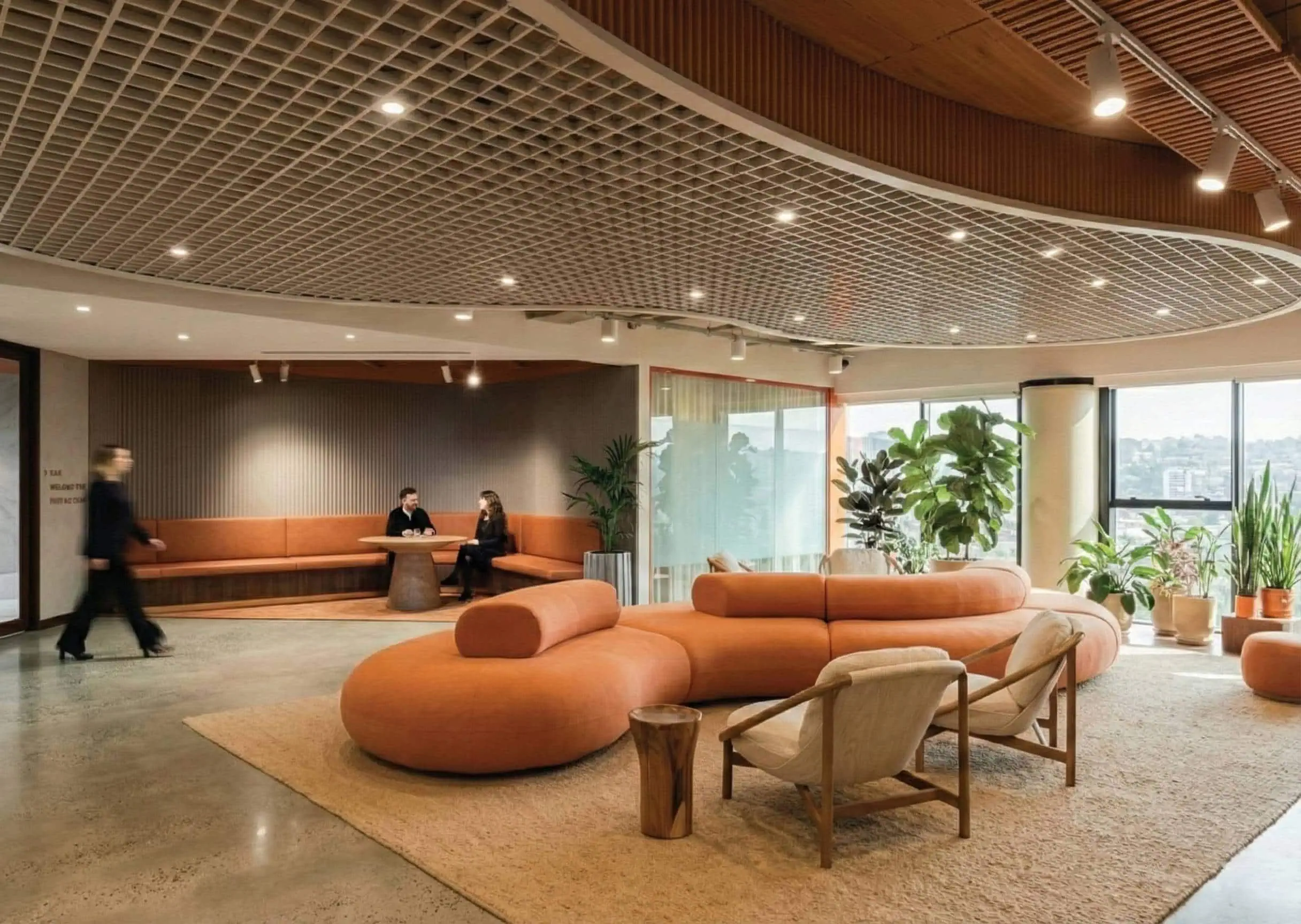
Image Courtesy: 7 Eleven GSC, Bengaluru | Cars of 7 Eleven
Taken together, the four moves serve one purpose: a hub that works in its first review and keeps working as the business grows.
GCCs in Asia will earn their place as core engines through the conditions they create for scarce AI and product talent to concentrate, exchange knowledge, review work and decide with clarity. Adding desks or enlarging the footprint does not create those conditions.
That takes spatial precision, supported by dependable AV, secure infrastructure and planning calibrated to each market. For the GCC leaders running these centers, Zyeta brings data-led workplace strategy, spatial planning built on real work patterns, integrated AV and technology planning, and regional design-build delivery across India, Singapore and Taiwan. The result is a hub that is efficient to operate, ready for business and positioned to own global products.
Planning your next GCC workplace? Talk to Zyeta about spatial strategy, AV integration and regional design-build delivery for product and AI development hubs.
Connect with Zyeta’s workplace strategy experts >>
Related Reads:
07 Strategic Workplace Design Imperatives for India’s Evolving GCCs
07 Design Strategies You Need to Build a Carbon-Neutral GCC Office