The carbon your net zero plan has not counted yet
A typical office interior carries about 190 kg of CO2e per square meter every time it is built, based on RESET project data. The core and shell of an office tower carries about 840 kg per square meter, but it is built once. Interiors are rebuilt. At an average interior life of 8.5 years, a workplace is rebuilt about six times across a 50-year building life, and RESET’s analysis puts those cumulative interior emissions about 32% above the core and shell.
For you as a decision maker, this means the carbon in your next fit-out, your next lease exit and your next relocation belongs in your net zero baseline. 2027 is when requests for that data widen. Reporting rules in India, Singapore and Taiwan are moving toward whole-life carbon, and each one can reach your workplace through your fit-out choices.
Find the hidden half of your net zero plan
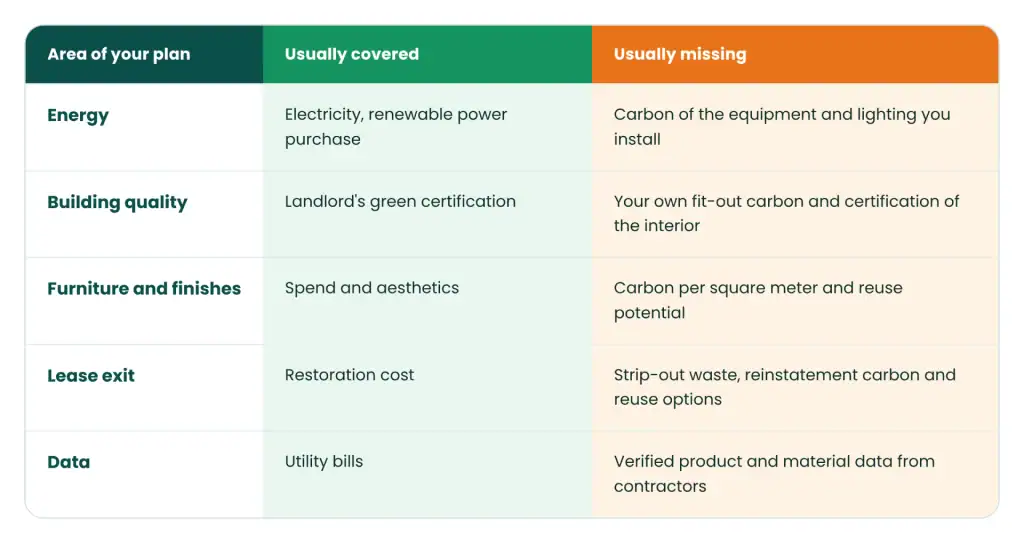
Most corporate net zero plans in Asia Pacific focus on energy. They track electricity use, buy renewable power and rely on the landlord’s building certification. These steps matter, and they cover the operating half of your footprint.
The hidden half is the embodied carbon in everything you put inside the building: flooring, ceilings, partitions, joinery, lighting, furniture and the waste created when a lease ends and the space is stripped back. Lifecycle data for office interiors also shows about 77 kg of waste per square meter, as summarized by 2050 Materials.
Lease terms decide how often this carbon is repeated. A Building magazine analysis describes fit-out as a carbon subscription and notes that a 15-year replacement cycle splits whole-life carbon about equally between building and interior, while typical leases run 5, 7 or 10 years. Under those lease lengths, your interior becomes the larger carbon item. One landlord’s analysis of its own fit-out projects found interiors can account for 60% to 80% of a building’s whole-life embodied carbon, and chairs are often one of the biggest single contributors.
Why 2027 is the planning year: what is changing in major asian markets
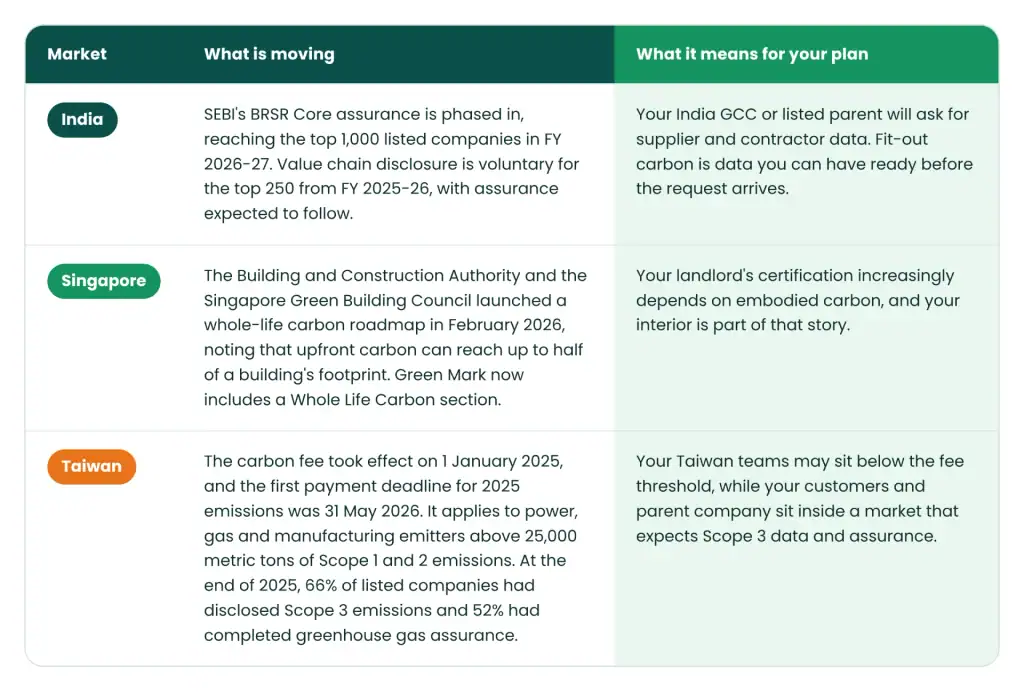
Three markets, three different routes to the same question: what is the carbon of your workplace, and can you prove it? The table shows what is moving in each market and what it means for your 2027 plan.
06 actions that make your workplace sustainability-ready in the next 12 months
Each action comes with an impact you can report to your leadership team.
- Add fit-out and lease exit carbon to your net zero baseline. You close a Scope 3 gap before assurance reaches it.
- Map every lease for reinstatement clauses, break dates and expiry dates. You see where carbon, waste and restoration cost are locked in by contract.
- Set a carbon budget per square meter for each project. Your design and procurement teams get a clear target.
- Require product carbon data and environmental product declarations from suppliers. Your carbon numbers become verifiable for auditors and investors.
- Negotiate reinstatement flexibility and reuse at renewal. You can leave sound interiors in place and avoid strip-out.
- Time each fit-out to your occupancy strategy. You stretch interior life beyond the 8.5-year average and cut carbon per year of use.
05 design solutions that lower your fit-out carbon
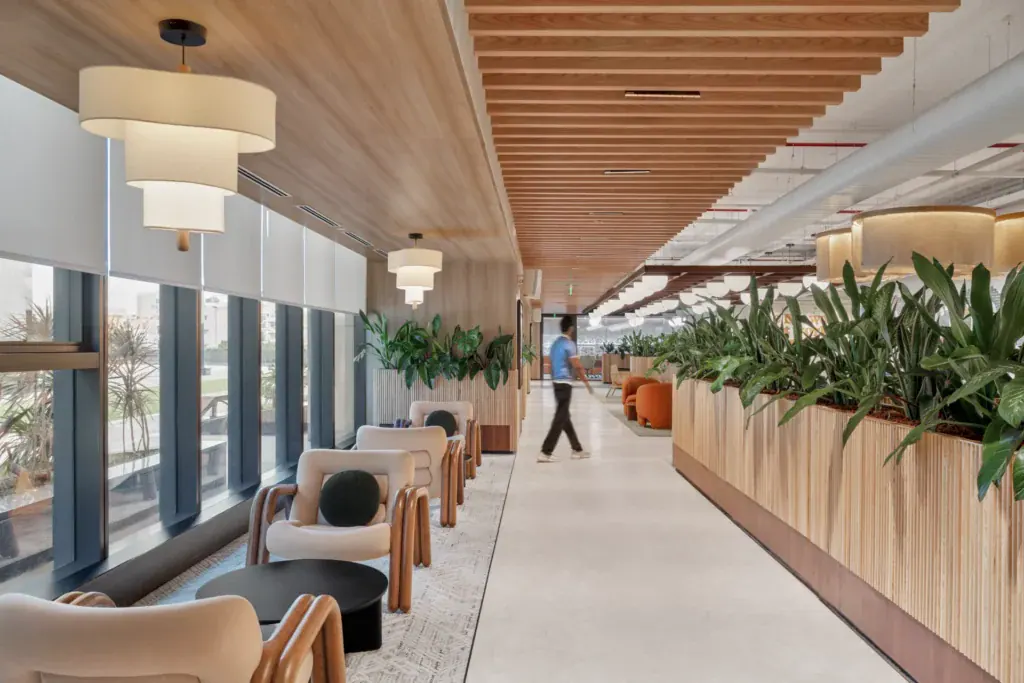
The levers below work together. Each one starts in the design brief, which is where you hold the most control over carbon and cost.
1. Retain first, then build
Your existing ceilings, services, flooring and partitions often have years of useful life left. A retain-and-refresh design keeps them in place and spends your budget on what your people notice.
Impact for you: less material bought, less waste hauled out and often a shorter program. In one published circularity case study, RESET reports an emissions reduction of up to 81.5% through full circularity.
2. Design the interior to last longer
Flexible planning, demountable partitions and modular furniture let the workplace adapt as teams grow, shrink or change how they work. Spread over time, 190 kg of CO2e per square meter works out to about 22 kg per year at an 8.5-year life and about 13 kg per year at 15 years.
Impact for you: extending interior life from 8.5 to 15 years cuts the annual carbon of the same fit-out by about 43%. You can check this figure yourself: it divides the RESET baseline of 190 kg by each lifespan.
3. Specify materials with verified data
You can ask for environmental product declarations, recycled content and take-back terms on the items that carry the most carbon. Seating, flooring and ceilings are common hotspots.
Impact for you: a bill of materials with carbon values that your auditors, investors and certification bodies can review.
4. Plan the lease exit on day one
Reuse, resale and refurbishment routes for furniture and finishes are easiest to arrange while the project is being designed.
Impact for you: a lower strip-out bill, less waste and a stronger case when you negotiate reinstatement terms with your landlord.
5. Measure carbon at every design stage
When carbon is tracked at concept, detailed design and build stages, your team can compare options and choose the lower-carbon one while changes are still cheap.
Impact for you: a carbon number per square meter at handover that matches the number in your brief.
Plan the hidden half now
Your net zero plan already covers energy. The next gain sits inside your interiors, where each rebuild adds carbon, waste and cost that a lease clause can repeat every 5 to 10 years. Regulators in India, Singapore and Taiwan are all moving toward whole-life carbon, and these expectations keep building toward 2030 and beyond. The businesses that hold fit-out carbon data in 2027 will answer each request with numbers already in hand, and that data carries forward into every later reporting cycle.
The path is clear. Count the carbon, set a budget per square meter, design for retention and longer life, and plan the lease exit on day one.
Book a fit-out carbon review with Zyeta. You share your lease schedule and your next planned project, and your Zyeta team returns a baseline, a carbon budget and a reuse opportunity list for your site.
Start a conversation about your 2027 workplace plan.
Sources
RESET: Embodied Carbon and Circularity for Office Interiors
2050 Materials: Are office fit-outs relevant for climate change?
Building magazine: We must avoid carbon tunnel vision in workplace design
British Land: How do you make every fit out more sustainable?
Southeast Asia Construction: Singapore’s built environment decarbonization roadmap, March 2026
KPMG India: From disclosure to demonstration, June 2026
Keslio: India BRSR requirements
Focus Taiwan: First carbon fee collection, June 2026
Slaughter and May: ESG in APAC 2025, Taiwan
Taiwan Stock Exchange: ESG Ecology and disclosure data
Related Reads:
07 Design Strategies You Need to Build a Carbon-Neutral GCC Office
How Singapore Workplaces Must Urgently Adapt to New Carbon Mandates in 2026?